Autumn 2026 Update
Welcome to the Autumn 2026 update from Medicine and the Making of Race.
There is plenty to catch up on since our last newsletter. In September 2025, the project’s initial five-year period of funding came to an end, and we were delighted to secure a further three years of UKRI Future Leaders Fellowship funding, taking MMoR through to September 2028.
This next phase builds on the substantial body of research, collaboration and impact developed during the first five years of the project, while opening up new avenues for research and engagement.
Over the past year, Hannah has continued her research and writing, alongside a programme of seminars, workshops and other activities supported by MMoR. We have also seen a number of exciting publications and other outputs emerge from the project and its wider research community. With Becca now back as Project Manager, we are looking forward to building on this work through an active programme of events, networks and impact activities over the coming years.
Publications
The past year has seen some major publications emerge from MMoR and its wider research community.
In May 2026, the Past & Present Supplement Medicine, Race, and Slavery in the Transatlantic World, 1600–1850, edited by Hannah Murphy and featuring articles by Hannah and Carolin, and other project collaborators, was published. The special issue brings together research exploring the interconnected histories of medicine, slavery and race across the early modern Atlantic world.
We are also delighted to celebrate the publication of Christianity and Race-Making: New Approaches, a special issue of Renaissance Studies edited by former MMoR Research Associate Eli Cumings. The issue grew out of MMoR’s research activities, specifically our two-day conference on Christianity and Racemaking and includes Eli’s introduction as well as her article, ‘Divine Providence, Racial “Monstrosity” and the English Reformation’.
And there is more to come. Growing out of MMoR’s network with archivists, a forthcoming article with the English Historical Review, ‘Towards a National Reckoning: British Institutions and Transatlantic Slavery, 2020–2025’, co-authored by Hannah, Michael Bennett and Jonathan Powell, is forthcoming this term. Watch this space for further details.
We are also looking forward to the publication of Medical Encounters in the Early Modern World, a collection of essays co-edited by Carolin Schmitz and Leah Astbury, forthcoming very soon with Manchester University Press. The first attempt to think heuristically about the place of ‘encounter’ in cross-cultural medical exchange, this volume will include chapters by Carolin on the plurality of patient voices in the archive, and by Hannah on worms and medical ethnography.
Research, seminars and events
MMoR’s research has continued to generate conversations, with Hannah contributing to a range of seminars, workshops and conferences over the past year. These have included delivering papers at the Trinity Centre for Early Modern History Seminar Series; an English Historical Review symposium at St John’s College, Oxford; the Portable Archives workshop at Exeter College, Oxford; and the launch of the Freedom Narratives website, an event sponsored by MMoR.
The project has also continued to support a wider programme of events, bringing together researchers from a range of institutions and disciplines. This has included a seminar series at the Institute of Historical Research supported by MMoR, with talks by Ana Lucia Araujo, Toby Green, Pablo Gómez and Lou Roper. We were also pleased to sponsor a book workshop with Hannah’s former colleague Sebastian Kroupa, focused on his forthcoming book, Drugs on the Move: Making Cross-Cultural Knowledge in Southeast Asia, c.1650–1750.
In May 2026, Hannah spoke at and MMoR sponsored ‘Institutions and the Art of Memory and Repair’, an event hosted by King’s Past. The event also marked the official launch of a major new output from the project’s impact programme: a toolkit developed through several years of discussion and collaboration within our London’s Records of Slavery network, alongside the project’s research.
Researching institutional involvement in Transatlantic Slavery
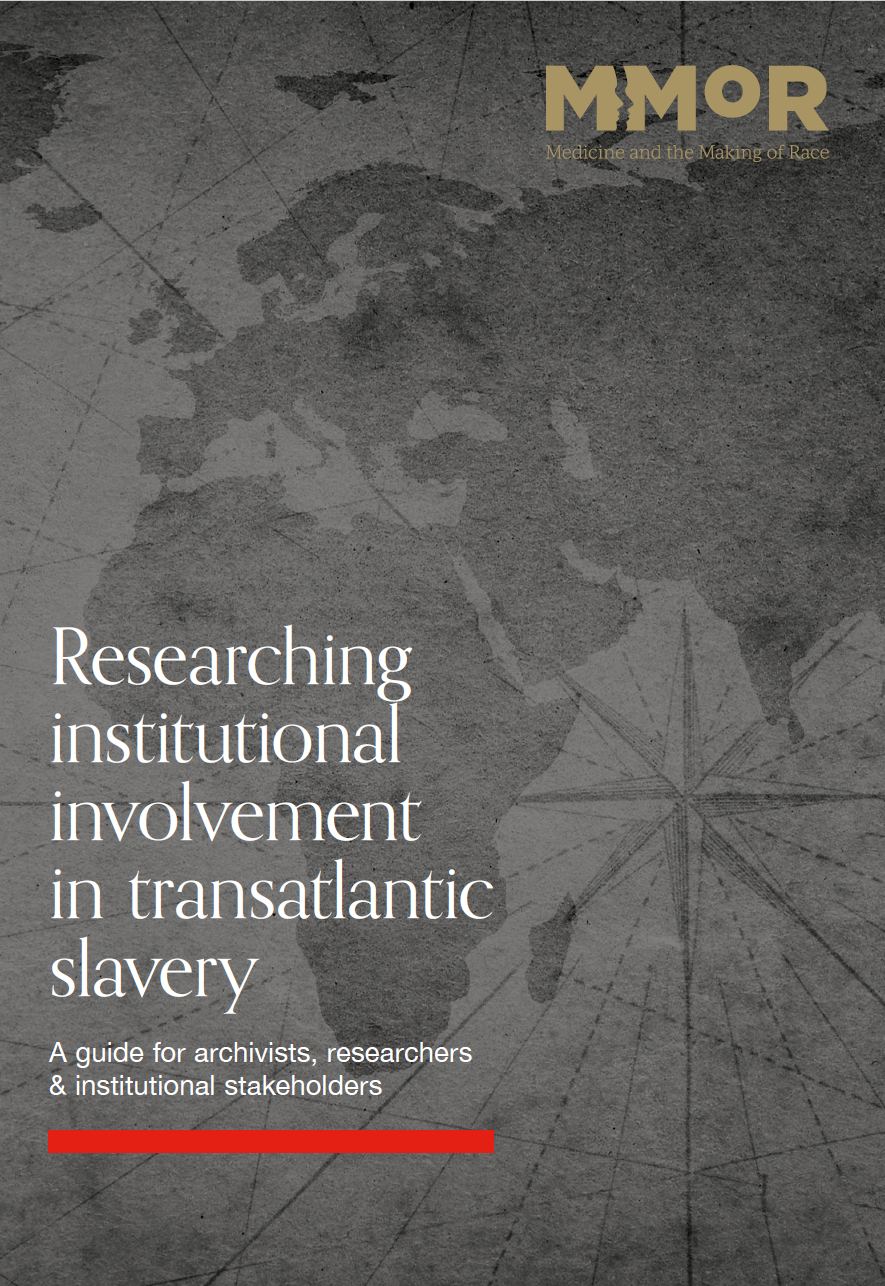
Researching institutional involvement in Transatlantic Slavery: a guide for archivists, researchers & institutional stakeholders offers practical guidance for organisations researching their historical connections to the transatlantic slave trade. Developed from the experiences shared by institutions involved in the London’s Records of Slavery network, the toolkit includes case studies from the Bank of England, Lambeth Palace Library, and Lloyds of London, alongside guidance on research design, working with sources and external researchers, consultation, and communicating findings.
The toolkit aims to share lessons from the network and support institutions undertaking this important work. Free copies can be requested via the MMoR website.
MMoR team news
There have been some changes to the MMoR team since our last update.
After several years with the project, Dr Carolin Schmitz completed her time with MMoR in September 2025. We are delighted that she has gone on to a position in the University of Trier, we look forward to following her work.
We are also very pleased to welcome former project member Dr Eli Cumings back to King’s College London. Following her time with MMoR, Eli spent two years researching and teaching at Columbia University, where she was a member of the Society of Fellows and a Lecturer in English and Comparative Literature. She has now returned to King’s as a permanent member of staff as Lecturer in Early Modern Literature.
Finally, Becca returned as MMoR Project Manager in August 2026 and is delighted to be back with the project. She is looking forward to developing the programme of events, networks and impact activities as MMoR enters its renewed phase.
Looking ahead
There is lots to look forward to over the coming year. We are restarting London’s Records of Slavery, our network for archivists, librarians, curators and researchers working on institutional histories of slavery, with meetings scheduled in October and November.
We also have a programme of seminars, workshops and other activities in development for the coming year, alongside further research and publications from the renewed project.
We’re excited to see where this next phase of MMoR takes us, and look forward to sharing our research and activities with you along the way.